
A Masterclass in Strategic Solidarity
How Bruce Springsteen used decades of trust with his white fanbase to challenge them to act.

I’ve been fortunate enough to see Bruce Springsteen in concert more than a dozen times, but the recent Land of Hope and Dreams tour felt very different in tenor and message. The music almost became a backdrop for the true purpose: an emotional plea to Springsteen’s faithful followers to confront the crisis of democracy unfolding in our country right now. As a longtime Springsteen fan and as someone who works on and writes about solidarity in America, I found his tour to be a masterclass in strategic solidarity.
Before going further, I want to acknowledge two things: first, I’m a huge admirer of Springsteen’s music, so I might not be the most neutral observer! Second, Springsteen is an elite musician and celebrity with far greater resources than the working class characters in his songs or his audience members. That reality makes me cautious about placing him on too high of a pedestal. Even so, there is a lot to learn from how Springsteen is using his platform in this moment. As many public figures have retreated into silence or self-preservation, Bruce has chosen a different path. And, in the ways that he challenges his white fanbase to take action, he offers importants lesson in strategic solidarity.
Right Messenger, Right Audience
What dawned on me as I sat in the arena during the last stop of his tour in Philadelphia was that Bruce wasn’t appealing to people of color like me (and yes, there are many of us who are Springsteen fans!). Bruce wasn’t speaking for immigrants, or for people already mobilized and civically engaged. He also didn’t expect those experiencing the immediate consequences of current policies - people of color, LGBTQ communities, undocumented immigrants – to be the ones holding the line or raising the alarm.
Instead, he used his identity and platform to speak to other white people with similar race and citizenship privileges. He challenged his predominantly white fanbase to pay attention, recognize their stake in this moment, and use their privilege to intervene and disrupt the country’s current direction.
That’s one of the central lessons of solidarity appeals: the right message requires the right messenger. There are moments when people must speak directly to their own communities. Springsteen understood that he was uniquely positioned to reach and influence an audience who might not receive the message in the same way if people outside their communities delivered it.
Leveraging Trust and Credibility
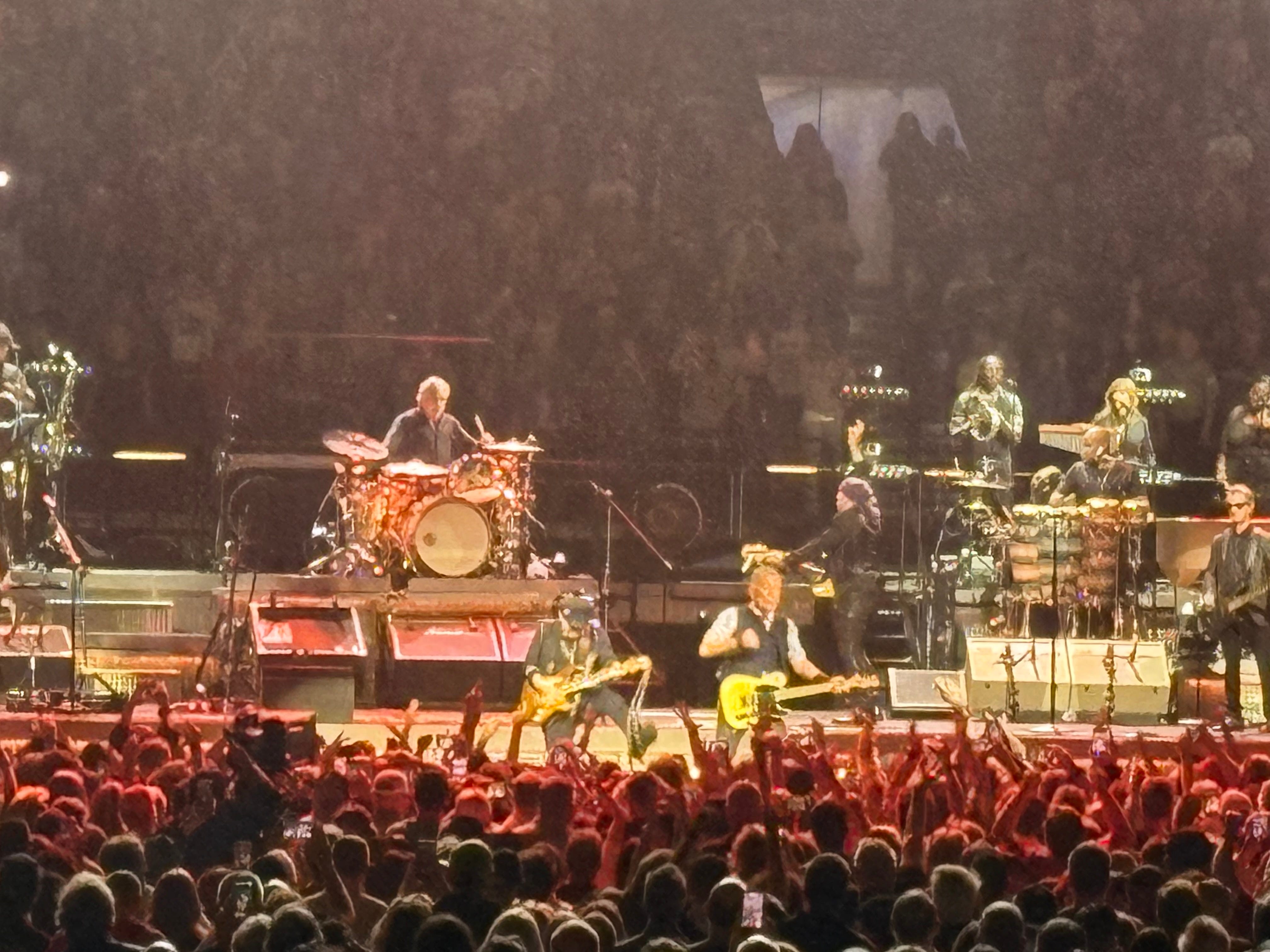
To reach his white fanbase, Bruce leveraged the trust and credibility he has earned over the past five decades with them. At the Philly concert I attended, I overheard a woman proudly saying, “I went to his first show in the 1970s!” A couple shared that they had followed Bruce up and down the East Coast for decades. A group of twenty-somethings accompanied their ecstatic parents eager to share Bruce’s music with them. These are die-hard fans for whom Springsteen concerts evoke nostalgia and a sense of belonging. In many ways, Bruce has become their trusted companion through both the glory days and the hard times.
Bruce seemed to instinctively know that trust is the cornerstone for solidarity practice. Instead of simply comforting and reassuring his audience that better days are on their way, he refused to let thousands of his fans be mere bystanders and passive spectators in the face of democratic decline. Instead, he relied upon the intimacy between him and his audience to reach and influence people who might otherwise be indifferent, disengaged, checked out, or numbed by the moment.
Being Clear About the Stakes
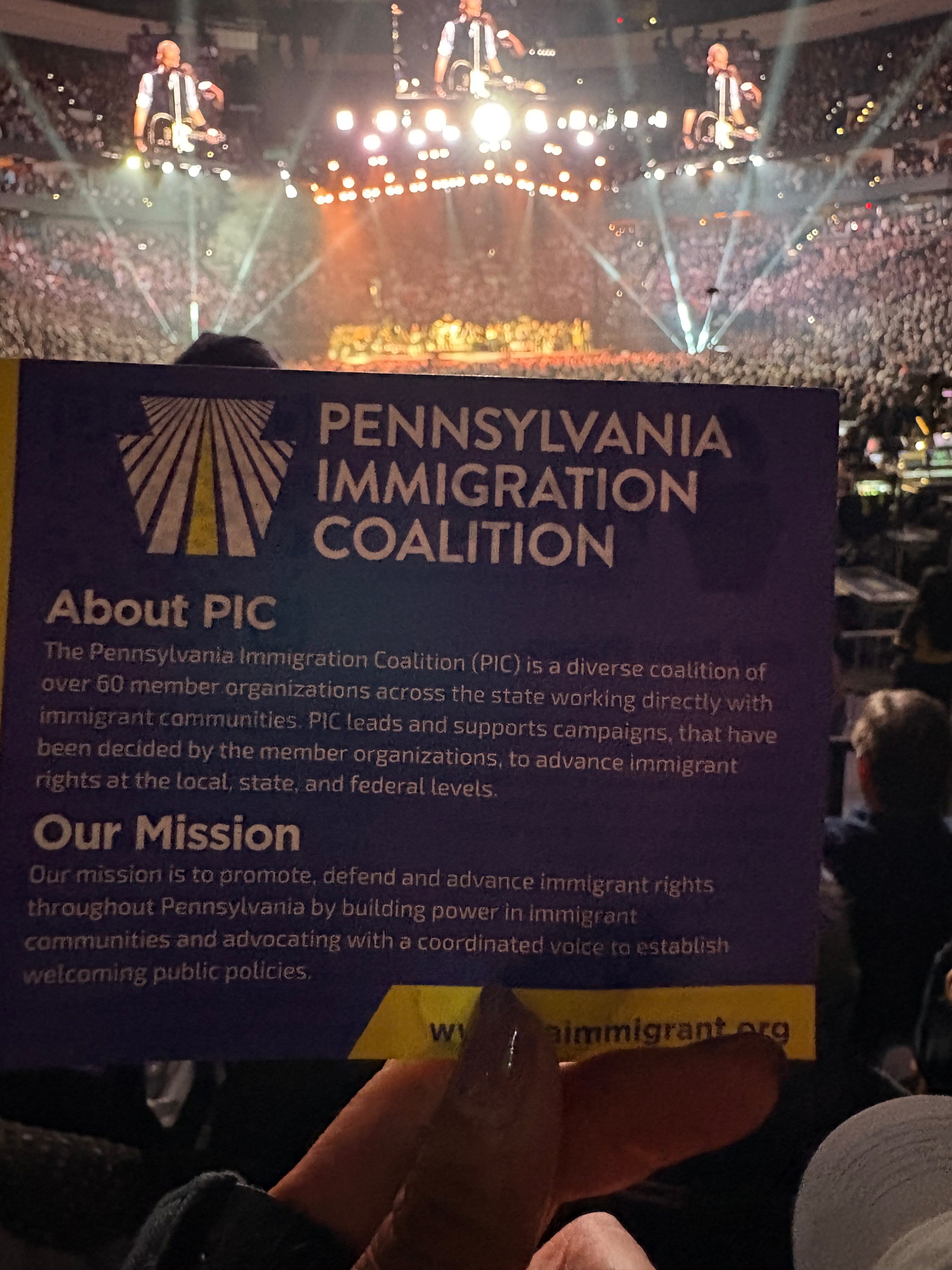
Every element of the concert felt intentional about the stakes right now: Bruce’s monologues, the setlist arrangement, the imagery and visuals, the collaboration with Tom Morello, the immigrant rights groups featured at each stop. Together, these choices reinforced Springsteen’s central message about our collective responsibility to stop the tide of authoritarianism.
The Philly concert began with the powerful anthem, War, immediately establishing the political stakes. Interspersed between crowd favorites like Hungry Heart and Because the Night were songs with a clear political and societal message like My City of Ruins, American Skin/41 Shots (in response to anti-Black racism, police brutality, and the murder of Amadou Diallo), and The Ghost of Tom Joad (a collaboration with Morello focused on the economic inequalities in society).
Midway through the concert, Bruce delivered a civics lesson for the audience. He chanted a litany of consequences to describe democratic erosion: the gutting of the Voting Rights Act’s protections, the lack of federal funding for vital programs and public benefits, the removal of exhibits from museums about slavery, the lack of due process, and the deplorable conditions at detention centers including at Delaney Hall in his home state of New Jersey which has been the site of protests this past month. After each example, he paused for emphasis and then said, “This is happening right now” to bring home the point that even if people aren’t seeing the headlines in the news, these events are still occurring all around them.
Bruce didn’t mince or sugarcoat his words either; he named the sources of democratic erosion, pointing to the White House and to the lackluster response of elected officials. For solidarity practice to be effective, it’s important to be clear about the systemic and root causes of inequity in this way, and Bruce didn’t shy away from speaking the truth.
But that wasn’t all. Beyond simply diagnosing the issues and raising awareness, Bruce also challenged his devoted audience to do something about it.
Making it Personal
Bruce is known for the use of storytelling and character development in his music. To get his white fanbase’s attention, he intentionally shared stories about white people who have been impacted by the current moment. Instead of evoking the familiar characters from his songs, he spent more time recounting the real-life stories of Alex Pretti and Renee Good, two white U.S. citizens who were killed by ICE agents in Minneapolis in January. During his protest anthem, “Streets of Minneapolis”, Bruce asked the audience to shout “ICE OUT NOW” louder and louder, as his fists pumped in the air. When the song concluded, video screens showed the faces of Good and Pretti. The images lingered for a while – no one could easily look away or ignore the message about ICE, the deportation crisis, and the impact on community members of all backgrounds.
Bruce seemed intent on reminding his white fanbase that they aren’t distant and separate from the issues at play, that they shouldn’t hide behind the excuses of “this isn’t my issue” or “things will get better in a few years.” In other words, Bruce was evoking what practitioners usually call “shared fates” – that what’s happening around due process, immigration, and endless wars should be taken seriously and should be everyone’s concern because we are (as he kept reminding us) each other’s neighbors.
Taking Risks
I wondered how the chants about ICE and the visuals of Pretti and Good landed on the audience. It is difficult to imagine that everyone at his concerts agreed with Springsteen or shared his vision of a multiracial America. In fact, it’s not a stretch to assume that there is overlap between Bruce’s audience and parts of Trump’s base. But the difference, as Simon Hall writes in The Oxford Review, is that there is now a “divergence of two competing visions for the working class in modern America.” Springsteen has been consistently vocal about his support of a diverse America where everyone belongs and should have access to fundamental rights and benefits - in direct opposition to a more narrow and dangerous vision of a white Christian nation.
What made the concert so compelling to me was that Springsteen wasn’t simply speaking to people who already agreed with him. He seemed willing to risk discomfort, critique and even alienation in order to challenge people he believed were still worth reaching.
Taking risks is also a part of strategic solidarity. And while Springsteen’s tolerance for reputational risk is undoubtedly wider than most people’s given his stature and wealth, his choice to spend his political and cultural capital - rather than protect it at all costs (a choice that many public figures with similar platforms have made) - is meaningful. “No retreat, baby, no surrender” is a refrain from a Bruce song that I love, and in this moment, he has chosen to use his influence and take a stand, no matter how it might impact him or how many of his fans disapprove.
It’s a reminder that true and lasting solidarity practice often requires some level of risk - bodily, reputational, financial, and more. Solidarity requires us to be ready to give up something in order to make room for people who have been marginalized, to disrupt the status quo, to bring about collective change.
Sending Clear Calls To Action
As the concert ended, Bruce invoked Representative John Lewis and asked his audience to “get into good trouble.” He challenged everyone to refuse indifference, and asked us to pay attention, to show up and speak out, to welcome the stranger and connect with our neighbors. He uplifted immigrant rights groups in each city he toured, particularly at a time when many of them have been singled out by the Administration and have lost funding.
Though the Land of Hope and Dreams tour is over, Springsteen is not finished. He plans to join Morello and other artists at the Power to the People Festival in the DC area in a few months. This is how solidarity becomes not a one-off act but an iterative practice that’s repeated time and again.
As the lights came up and thousands of fans streamed out of the stadium, I felt a mix of pride, curiosity and hope. Would people only remember the rousing sing-along to Born to Run – or would they leave with a sense of responsibility? Would they take steps to reach out to their immigrant neighbors, advocate with elected officials, speak up about their views, and support the organizations that Bruce uplifted?
Bruce seems to believe that his fans – and our country – are worth fighting for. And at a time when I’ve found myself growing increasingly cynical and jaded, Bruce’s music and message (as it often does) helped me believe in that possibility a bit more too.
resources on solidarity:
» Building Movement Project’s SolidarityIs and Solidarity Is This podcast; Solidarity Lessons Movement Brief and Solidarity Stances)
» Race Forward’s Just Narratives for Multiracial Solidarity
»Blis Collective’s Solidarity and Narrative Infrastructure
»Narrative Initiative’s Why People Join Movements
»SURJ: A home for white people working for justice